WhatsApp is among the top messaging applications globally, which also means it is continually under the threat of abuse. One of the lesser-known, but increasingly discussed dangers is WhatsApp ghost pairing. It is common for people not to be aware of its existence until their privacy has already been compromised. Let’s understand it better, how it works, and how you can secure your WhatsApp account.
What Is WhatsApp Ghost Pairing?
WhatsApp ghost pairing is a technique where an individual secretly links their device to your WhatsApp account via the Linked Devices feature. After pairing, the intruder can monitor your messages live without alerting you. Unlike the usual WhatsApp hacking method that involves stealing your SIM card or OTP, this method doesn’t require the thief to have the OTP each time the account is accessed.
How WhatsApp Ghost Pairing Works
WhatsApp users can receive a message that is often termed as bait. The hackers can send this message from a known or an unknown contact and will usually contain a message depicting some sort of urgency, asking to click on the malicious link. Once the user clicks on the link, the user is directed to the Phishing site, which asks the victim to enter the details. Once the account is compromised, the attacker uses the compromised account to send lure messages to saved contacts. Recipients are more likely to click a malicious link from a known, trusted source, perpetuating the cycle. The problem with this is that the victim whose account is compromised won’t even know that their account is now linked to an attacker’s system, and the attacker archives sent messages to keep the victim unaware of the spamming.
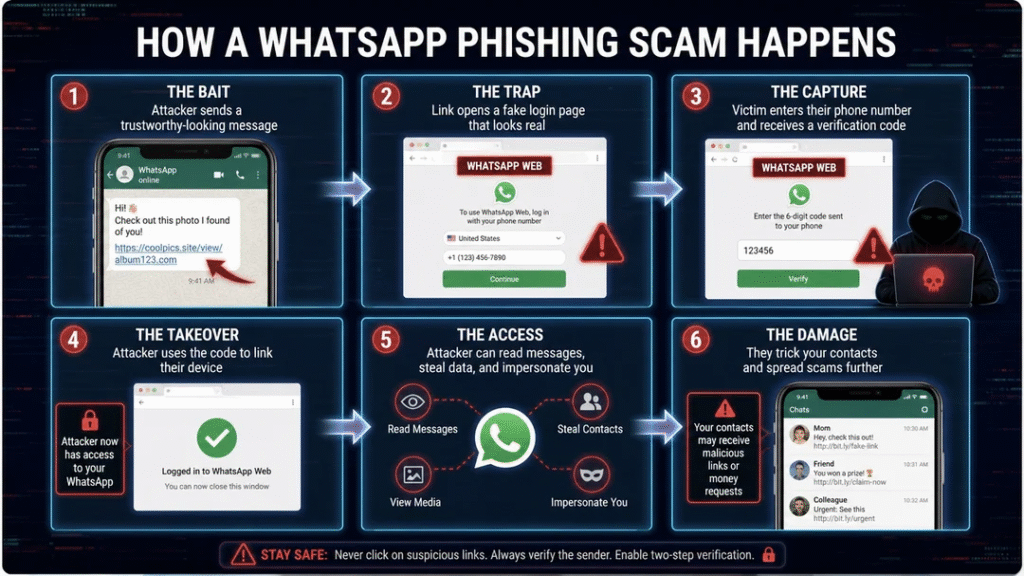
Attackers then have full access to your chat history, real-time messages, and contact list, allowing them to impersonate you and target your friends and family with further scams.
Afterward, the communication via chat will be synchronized without the need to do it manually. That is the reason why the issue of WhatsApp hacking without OTP has become a growing concern. The feature is totally legitimate, but the misuse of it leads to a WhatsApp privacy breach.
Signs Your WhatsApp Is Ghost Paired
Most people ask the same question: “How do you know if this is happening?” To help them, here are the most common WhatsApp account hacking signs to watch for:
- New unknown devices are present in the Linked Devices section
- Receiving read receipts on your messages while you never accessed them
- Your WhatsApp Web account appears to be accessed from different locations without your knowledge.
- Unexpected decrease in the device’s battery life or unplanned background activity
Key data on related scams include
- 6.8 Million Accounts: In the first half of 2025, Meta disrupted over 6.8 million accounts associated with scam operations that included taking over accounts and using linked devices.
- India 2026 Crackdown: As of April 2026, WhatsApp has banned over 9,400 accounts linked to “digital arrest” impersonation scams in India since January 2026, many of which use device-linking techniques.
- Rise in “Scambling”: Reports of betting/investment scams—which often utilize compromised, linked accounts—increased significantly, with some regions seeing a 90%+ increase in reports.
- 3.5 Billion Exposure: A 2025 report revealed that a privacy vulnerability exposed 3.5 billion profiles, aiding scammers in identifying active users to target, which is often a precursor to account-takeover scams like the linked-device attack.
- In a real-life Singapore Case (April 2026): A 66-year-old man in Singapore fell victim to this scam, resulting in over S$3,000 lost. The victim was tricked into sharing an OTP (One-Time Password) that allowed scammers to link his account to their own devices. Once in control, the scammers messaged his contacts—often targeting those who frequently interacted with him, such as friends who exchanged daily “good morning” messages. The victim’s sister was also compromised. Three victims in total fell for the impersonation, losing S$1,000 each. The victim’s account could not be immediately recovered, forcing him to change his phone number.
How to Prevent WhatsApp Ghost Pairing
What makes it less scary is the fact that it requires only slight caution for you to be able to prevent it. You will be safer by doing the following:
Firstly, do a Linked Devices check regularly and disconnect any device that has been connected without your knowledge. This is like an instant block for unauthorized persons if you do it right away.
Secondly, set up two-step verification in your WhatsApp security settings. It isn’t a complete solution to keep pairing at bay, but it helps a lot if a wrongdoer tries to fool a system by means of account re-registration.
Thirdly, your phone shouldn’t be left unlocked and unattended anywhere, be it public or shared spaces. Most WhatsApp-linked device hacks happen due to physical access, not remote exploits.
Lastly, upgrade your app regularly. Updates to the security continuously fix possible weaknesses to get perfect WhatsApp privacy protection.
Note
As of March 2026, Meta has launched new anti-scam tools designed to fight the rising “linked devices” scam on WhatsApp. These updates aim to prevent attackers from hijacking user accounts by tricking them into linking a malicious device. [Source]